

What is the difference between 3D and Realism tattoos?
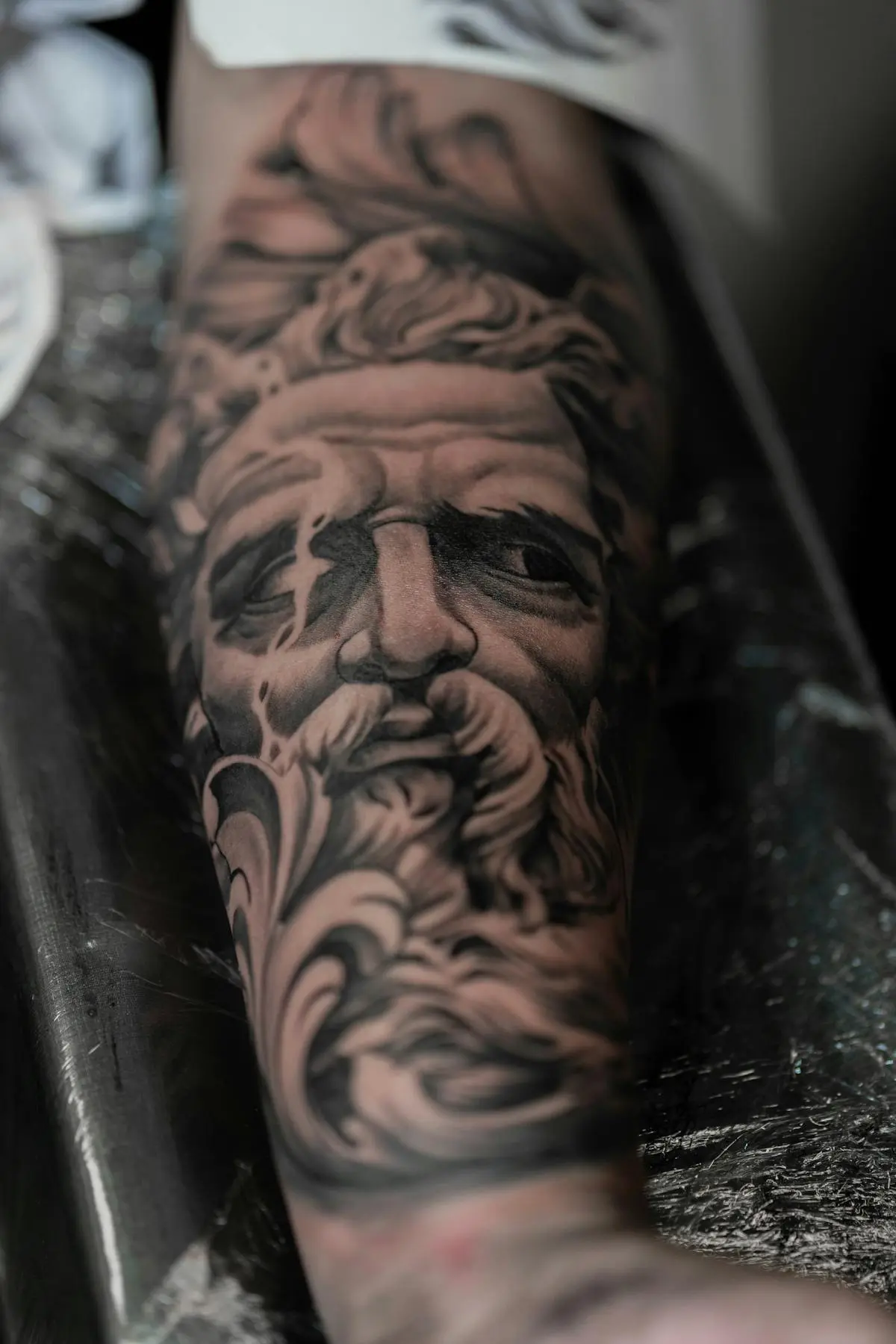
Realism is judged against a reference. The benchmark is a photograph or oil painting: no outlines, edges created only by value transitions, and gradients so smooth you cannot see where one tone becomes the next. The skill is translating three-dimensional lighting on a real subject (a face, a pet, an animal) into skin.
A 3D tattoo borrows the same shading skills and points them at a trick. Nothing is raised; the artist paints cast shadows, soft gradients and bright highlights so your eye reads a torn-skin window, a button or a spider as physically there. The subject can be impossible in real life, because the point is the illusion rather than a likeness.
The 3D effect is also angle-dependent. It pops from the viewpoint the artist composed it for and reads flatter from other angles, which is why placement matters more here than it does for a portrait.
How do you tell 3D and Realism apart?
Ask what the tattoo is trying to make you believe. A convincing likeness of a person, animal or scene is realism. A design that seems to rise off, sink into or tear open the skin is 3D.
| Attribute | 3D | Realism |
|---|---|---|
| Origin | Trompe-l'oeil · realism tradition · 2000s | USA · 1970s, matured 1990s |
| Typical price | $180–$350/hr, with strong artists often booked by the piece | $200–$400/hr |
| Core palette | Black, Greys (full value range) | Full spectrum (color realism), Black and grey (B&G realism) |
| Best for | Flat, broad placements like the forearm, calf, or upper back where the illusion reads cleanly | Portraits, pets, single-subject pieces |
| Skip it if | You want a tattoo that looks the same crisp way for 20+ years with minimal touch-ups | You want crisp longevity with zero touchups |
| Watch as it ages | Highlight contrast. Ask how the artist protects the lightest values, and keep the piece out of the sun. | Contrast. Ask to see healed realism from your artist several years out. |
Does 3D or Realism age better?
Neither style is forgiving, for related reasons. In 3D the lightest highlights and the shadows that sell the depth soften first, and once the values flatten toward the midtones the illusion goes with them. Realism depends on dense, even ink packing and enough scale; done small it blurs, and collectors should expect a touch-up every 5 to 8 years. Sun protection matters for both.
Run a design in each style from healed to 20 years, by size, placement and sun.
An illustrative model, not a prediction.
Does 3D or Realism cost more?
3D typically runs $180–$350/hr, with strong artists often booked by the piece. Realism runs $200–$400/hr, usually in long sessions.
Prices vary a lot by city and artist; how much a tattoo costs breaks down what drives them.
Which should you get?
- You want a conversation piece that plays tricks on the eye
- You have a flat, stable placement such as the forearm, calf or upper back
- You will pay a genuinely skilled shader, because weak shading kills the effect
- The subject has to look like a specific person, pet or photo
- You can supply a sharp, well-lit reference
- You are going large and can sit for long sessions
Can you combine 3D and Realism?
They overlap more than most pairs: 3D is described as growing out of the realism tradition, and both start from strong black-and-grey shading. Ask for an artist whose healed portfolio shows the specific thing you want, not just one of the two.
Whichever you lean toward, pick the artist before the design: look for healed work in that style, not just fresh photos. How to choose a tattoo artist has the checklist, and what tattoo style should I get helps if you are still deciding between more than two.