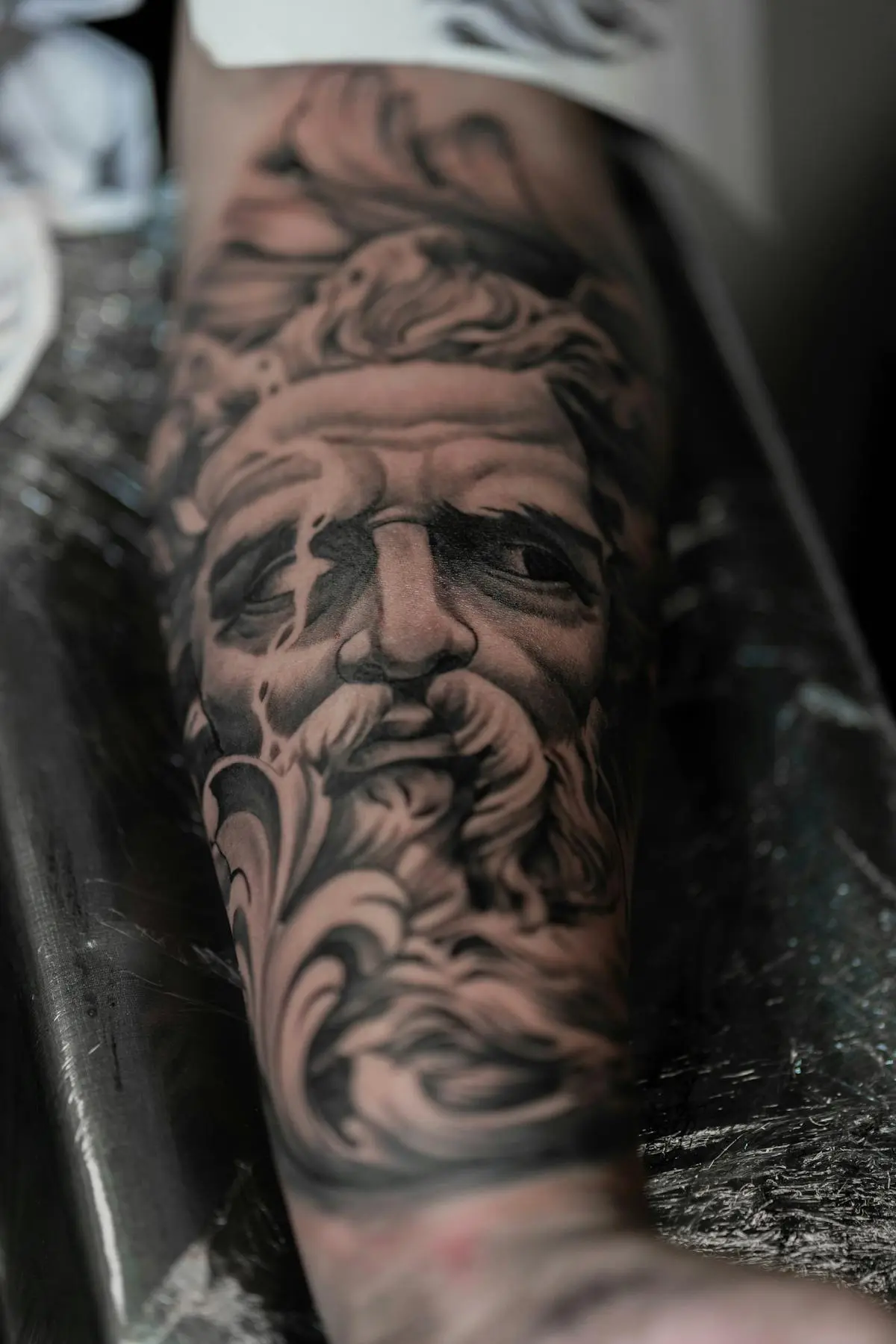
Realism is the style where the benchmark is a photograph. No outlines defining forms, no stylization, no interpretation: just the translation of a reference image into skin through seamless value gradients and precise tonal control. Done at its best, a realism portrait sits against the skin and reads as three-dimensional. Done poorly, it's the worst-aging style in tattooing: muddy, blurry, and indistinct within five years of application. Realism as a distinct tattoo category emerged in the United States in the 1970s, grew significantly through the 1990s as artists like Nikko Hurtado pushed color realism into photographic territory, and has since split into two largely separate specialties: black-and-grey realism, which builds tonal range from black ink and grey wash, and color realism, which requires the additional complexity of accurate hue matching alongside correct value relationships. The technical difficulty is enormous and specific. The skill isn't drawing ability in the conventional sense; it's understanding how ink spreads and softens under healed skin over months and years, and compensating for that movement during the session. An artist who packs ink correctly will produce work that tightens and clarifies as it heals; an artist who doesn't will produce work that looks sharp fresh and muddy at six months. The only way to assess this is healed work, which is why asking for three-plus-year portfolio examples is non-negotiable. Realism also demands scale: portrait-level detail requires a palm-sized minimum, and the fine gradients that make the style work close up in any placement smaller than that.
Pick this style if...
- Portraits, pets, single-subject pieces
- Collectors who'll accept a touchup every 5–8 years
- Large-format work (palm-sized and up)
Skip this style if...
- You want crisp longevity with zero touchups
- The subject has high contrast demands at small scale
- You're not willing to sit for 6+ hour sessions
Notable artists
A starting point. Follow their work, don't just book the first DM-slot you can get.
- Nikko Hurtado
- Dmitriy Samohin
- Steve Butcher
The rules of the style
- No outlines: realism does not use black outline to define form. All edges are created through value transitions, exactly as in a photograph or oil painting.
- Smooth, seamless gradients: the technical benchmark of realistic tattooing is how invisibly one value transitions to the next. Banding, stepping, or visible directional strokes are craft failures.
- Reference-driven: every realistic tattoo is working toward a specific reference. The skill is translating a photograph's three-dimensional lighting information into ink on skin, not interpreting or stylizing it.
- Ink saturation is everything: realistic tattoos depend on dense, smooth ink packing. Areas that look photographic when fresh but fade to a patchy grey within two years are a sign of poor ink saturation during the initial session.
- Color realism is significantly harder than black and grey: adding color to the realism constraint requires the artist to match photographic color accuracy AND achieve smooth gradients in multiple hue channels simultaneously. Require more extensive portfolio review for color realism.
- Large scale holds better: realism degrades at small scale because fine detail closes up as ink spreads over time. Experienced realism artists will require adequate size for portrait-level detail.
Color palette
- Full spectrum (color realism)
- Black and grey (B&G realism)
- Every color that appears in the reference image (secondary)
Black and grey realism and color realism are distinct skill sets. An artist who excels at one may not excel at the other. Review portfolios separately for each.
Aftercare for this style
Realism follows the same basic fresh-tattoo routine as other styles: follow your artist's instructions, keep the area clean, and protect the healed tattoo from UV exposure.