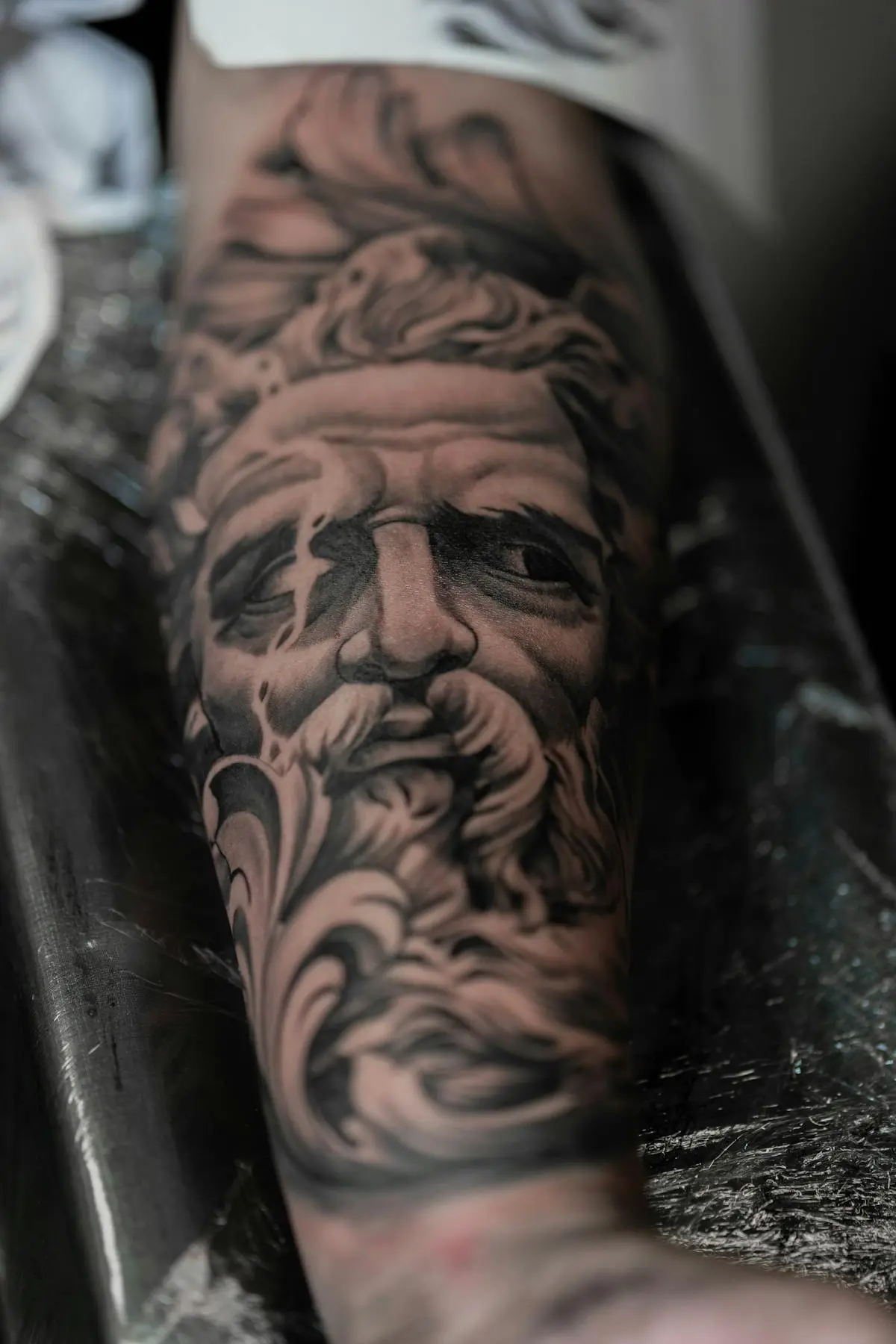
Black and grey uses only black ink, diluted in stages called grey wash. It was born in 1970s LA prison culture, where color ink wasn't available, and was refined through Chicano tattooing before spreading to studios worldwide. The style achieves near-photorealism while sidestepping the color-shift problem: black inks hold their value range far longer than any color pigment. A properly executed B&G sleeve at 20 years still reads as a faded version of itself, not a muddy mess. The technique requires more sessions and more skill than most people expect. Building a full value range from near-black to bare skin takes multiple passes at different dilutions, and smooth gradient transitions, the technical standard, don't happen in a single pass. Expect hourly rates in the $200–$350 range, and more hours than a comparable color piece. Reference and subject matter matter. Portraits, religious imagery, botanical work, and memorial pieces dominate because the style rewards subtle shading and tonal control. That same subtlety means skin tone affects the result: bare skin serves as the lightest value in the composition, so the visual range available differs between lighter and darker skin tones. Ask your artist how they handle that: it reveals whether they're thinking about your specific skin as part of the design or applying a generic template.
Pick this style if...
- Portraits, religious imagery, fine art references
- Collectors who want realism but value longevity
- Large-scale sleeves and back pieces
Skip this style if...
- You want bold high-contrast like American Traditional
- You want a quick session, since this style is slow
Notable artists
A starting point. Follow their work, don't just book the first DM-slot you can get.
- Jack Rudy
- Freddy Negrete
- Carlos Torres
The rules of the style
- Black ink diluted to grey: black-and-grey tattooing uses a single black pigment diluted to various concentrations of grey wash, creating the full value range from near-black to barely-there smoke.
- No color, no outline as crutch. Form is defined entirely through value. Where color work uses hue to separate elements, B&G relies on careful value contrast, which requires more compositional discipline than color work.
- Smooth gradient transitions: the technical standard is seamless value transitions. You should not be able to see where one grey tone ends and another begins.
- Versatile subject matter. B&G works across realism, illustrative, script, portraits, florals, and abstract work. It is a technique more than a style, applicable to almost any subject.
- Skin is the highlight. Experienced B&G artists use the skin's natural tone as the lightest value in the composition. Areas left untattooed are not gaps; they are deliberate highlight values.
- Ages predictably. B&G tends to age more gracefully than color work because there is no hue shift (colors can go muddy; grey just softens). Properly executed B&G at 20 years looks like a faded version of itself, not a different tattoo.
Color palette
- Black
- Dark grey
- Mid grey
- Light grey
B&G is a technique, not a style vocabulary. It can be applied to realism, illustrative, chicano, portrait, floral, or abstract work. The grey-wash technique is what defines it, not the subject matter.
Aftercare for this style
Black-and-grey shading can look darker, warmer, or less even during the first weeks because redness and the temporary surface layer alter the value range. Do not judge smooth gradients while the tattoo is peeling. Follow the artist's cleaning and moisturizing plan, avoid friction over heavily shaded areas, and wait until the piece is fully settled before evaluating light spots or booking a touch-up.