
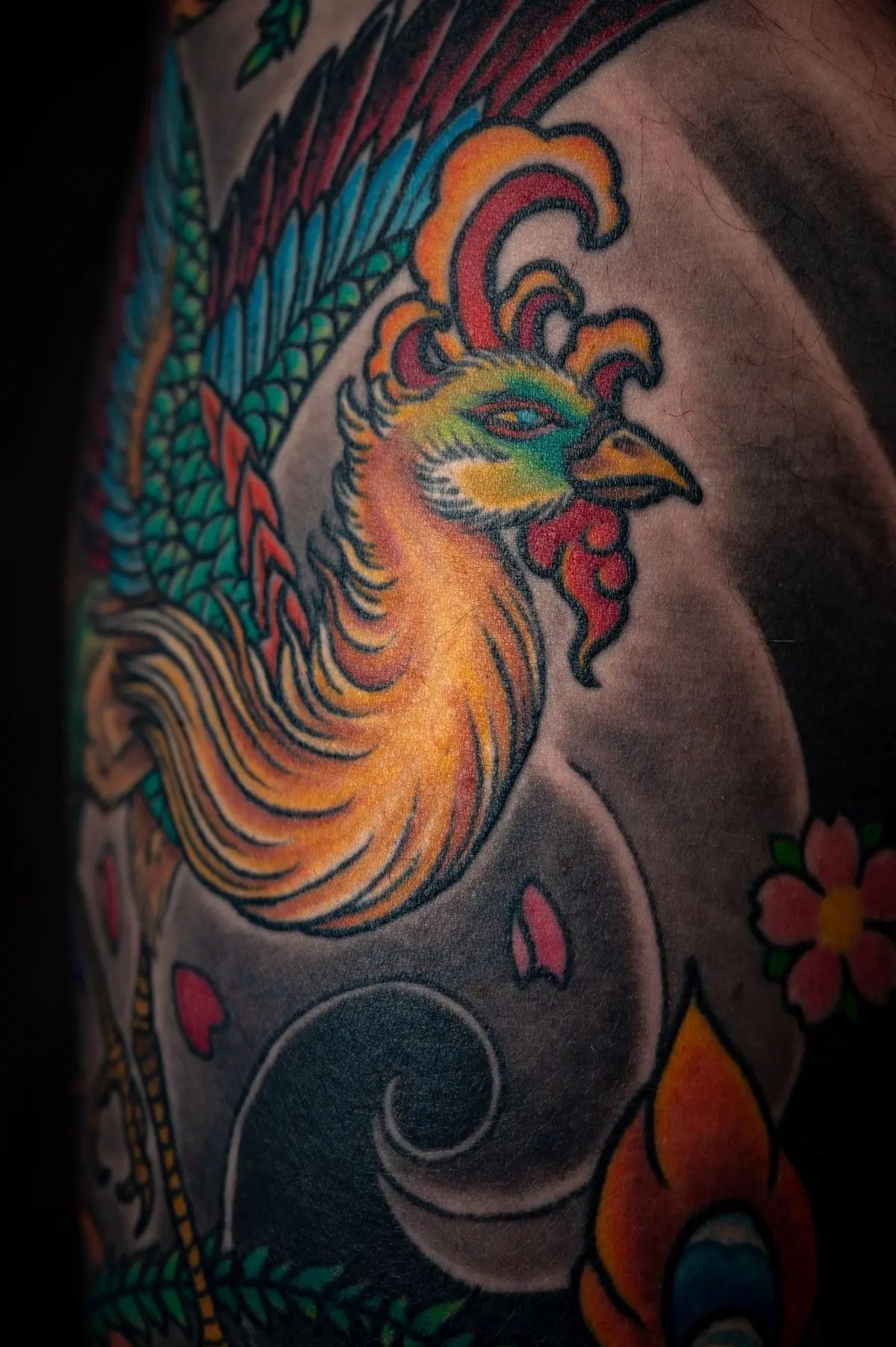
What is the difference between Neo-Traditional and New School tattoos?
They are siblings off the same parent. New School came out of the late 1980s and 1990s, when American graffiti, comic illustration and wild-style lettering crossed into tattooing. Neo-Traditional developed through the late 1990s and 2000s, as artists trained in American Traditional started studying illustration, printmaking and fine art.
New School exaggerates on purpose: heads too big, eyes oversized, perspective bent toward the comic page, with saturated purples, electric greens and day-glo oranges chosen for impact rather than to describe light. Its shading is stylized, often comic-style cel shading. Neo-Trad layers its color to model shadow, highlight and form so the piece looks painted, keeps proportions closer to natural, and often frames the subject with banners, ornamental borders or filigree.
How do you tell Neo-Traditional and New School apart?
Ask whether it belongs on a comic book cover or a gallery wall. The comic book is New School. Proportions are the quickest giveaway: if they are pushed past realistic, it is New School.
| Attribute | Neo-Traditional | New School |
|---|---|---|
| Origin | Early 2000s evolution of American Traditional | United States · late 1980s–1990s graffiti and comic art crossover |
| Typical price | $180–$300/hr | $175–$280/hr |
| Core palette | Black, Deep red, Forest green, Cobalt blue | Black (outlines), Saturated primaries: red, blue, yellow |
| Best for | Collectors who love traditional aesthetics but want more color range | Pop-culture subjects, cartoon characters, and gaming references |
| Skip it if | You want photographic realism | You want something subtle or timeless: New School is the opposite of both |
| Watch as it ages | Lighter tones and fine interior detail. The outline will outlast them. | Sun exposure. Bright color is UV-sensitive. |
Does Neo-Traditional or New School age better?
Both lean on heavy outlines, so both stay legible. Neo-Trad ages almost as well as Traditional, with its shaded color softening gracefully. New School’s outlines hold the same way, but it packs more color variety and tighter gradients into each area, so expect the pop of saturation to fade over the first 5 to 10 years while the piece stays readable.
Run a design in each style from healed to 20 years, by size, placement and sun.
An illustrative model, not a prediction.
Which should you get?
- You want a stylized subject that feels elegant rather than cartoonish
- You want it to sit alongside traditional work
- You want more color range than Traditional without giving up its structure
- Your subject is pop culture: cartoon characters, gaming icons, sneakers, street art
- You want maximum visual energy over technical refinement
- You do not mind a look tied to its era: peak New School reads distinctly early 2000s
Whichever you lean toward, pick the artist before the design: look for healed work in that style, not just fresh photos. How to choose a tattoo artist has the checklist, and what tattoo style should I get helps if you are still deciding between more than two.