What is the difference between Polynesian and Tribal tattoos?
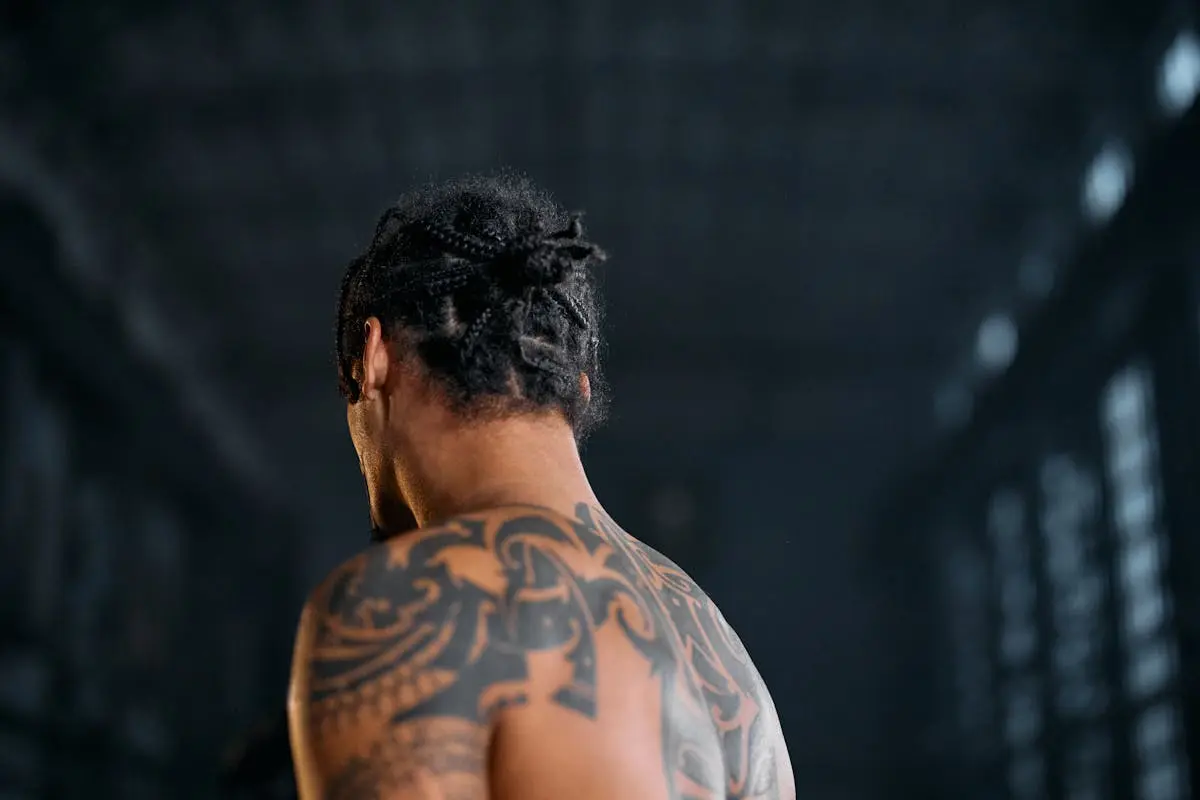
Tribal is a category, not a style: dozens of indigenous traditions across the Pacific, Asia, Africa and the Americas, including Filipino Kalinga batok and Dayak tattooing alongside the Polynesian ones. What they share is solid black forms that follow the body’s contours and carry meaning about lineage, rank and life events.
Polynesian narrows that to the Pacific, and even there the traditions are not interchangeable. Samoan pe’a is a body suit from the waist to the knees, done with handheld bone and shell tools. Maori tā moko encodes genealogy in curvilinear spirals. Marquesan work uses dense geometric fills based on natural forms like turtles, sharks and the sun. Hawaiian kakau is being revived after near-extinction. Generic Western tribal from the late 1990s took the bold black fills and angular spikes and left the grammar behind.
How do you tell Polynesian and Tribal apart?
At a glance they can look alike: solid black, no color, no shading. The difference is whether the motifs belong to a specific tradition. Authentic Polynesian work follows a recognizable vocabulary and is designed around the muscles it sits on; a generic tribal armband is a flat graphic of spikes and swooshes.
| Attribute | Polynesian | Tribal |
|---|---|---|
| Origin | Pacific Polynesia · 2000+ BCE, multiple distinct traditions | Multiple indigenous traditions · 3000+ years |
| Typical price | $200–$400/hr for Western artists specializing in Polynesian; traditional hand-tap practitioners vary significantly | $150–$300/hr · traditional hand-tap pricing varies |
| Core palette | Black | Black |
| Best for | People with cultural ties to a specific Pacific tradition | People with cultural ties to a specific tradition |
| Skip it if | You want a small decorative piece: traditional Polynesian work is architectural and large-scale by design | You want the generic 1998 tribal armband (seriously, don't) |
| Watch as it ages | Pattern scale. Fine repeating motifs need enough size to stay distinct. | Narrow points and tight gaps between black shapes. |
Does Polynesian or Tribal age better?
Both age extremely well. Solid black fills at traditional scale and density hold their shape for decades, which is part of why these traditions survived for millennia. What to watch is narrow points, tight gaps between black shapes, and fine repeating motifs shrunk too small to stay distinct.
Run a design in each style from healed to 20 years, by size, placement and sun.
An illustrative model, not a prediction.
Does Polynesian or Tribal cost more?
Western artists specializing in Polynesian work typically bill $200–$400/hr; tribal runs $150–$300/hr. Traditional hand-tap practitioners vary significantly in both.
Prices vary a lot by city and artist; how much a tattoo costs breaks down what drives them.
If you do not have cultural ties
Both guides land in the same place. For the major traditions, especially pe’a and tā moko, the cultural context of what is tattooed and where is not optional, and in source cultures these marks are earned or inherited. If you are drawn to the look rather than a specific heritage, blackwork or geometric give you bold, body-conforming black work without borrowing someone else’s genealogy.
Whichever you lean toward, pick the artist before the design: look for healed work in that style, not just fresh photos. How to choose a tattoo artist has the checklist, and what tattoo style should I get helps if you are still deciding between more than two.