

What is the difference between Old School and Traditional tattoos?
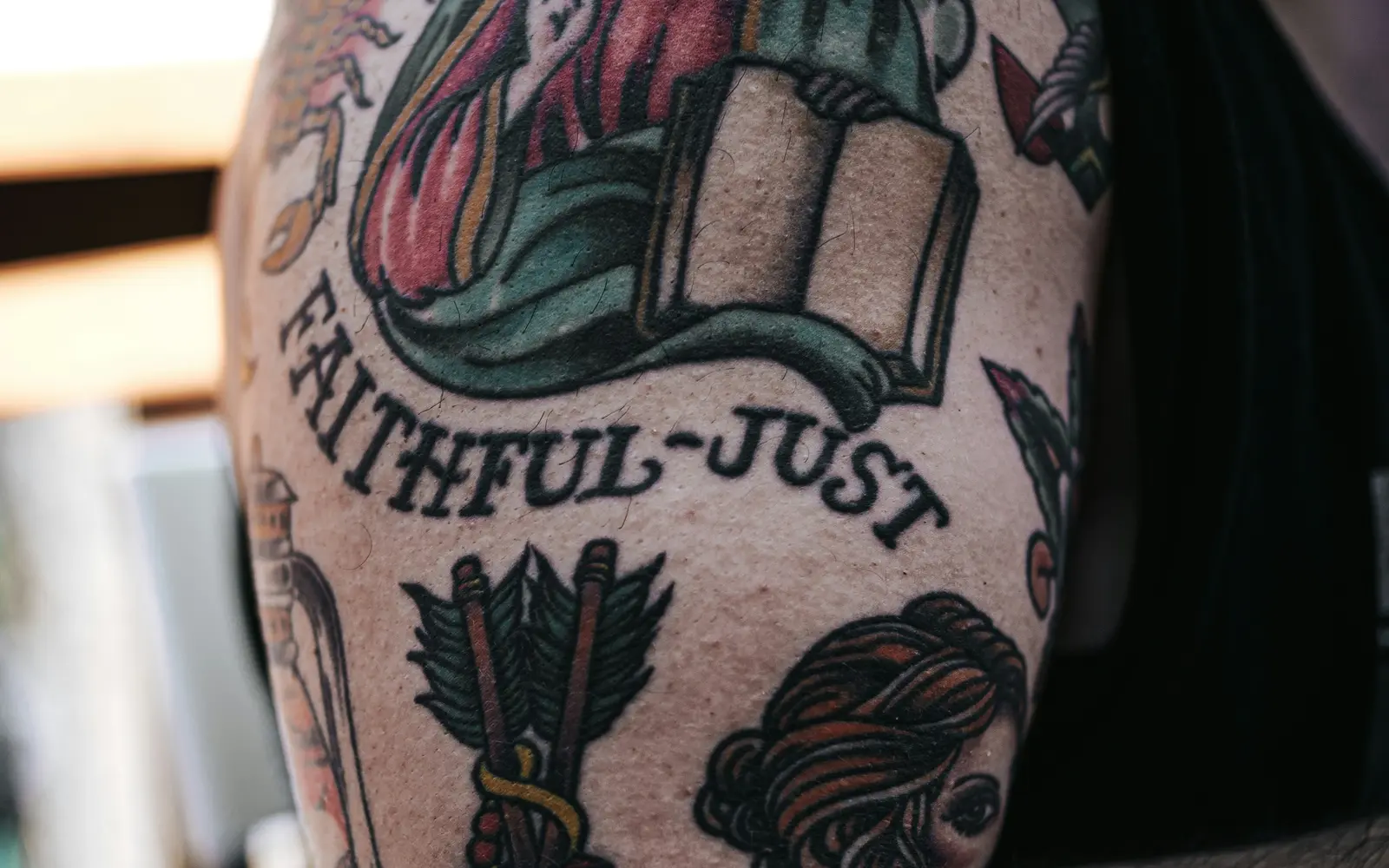
Both names point at the tattooing that came out of American port cities and naval parlors in the first half of the 20th century, shaped by artists like Norman "Sailor Jerry" Collins in Honolulu and Charlie Wagner in New York. The rules are identical: heavy black outlines, flat solid fills with no gradients, a short palette built on black, red, yellow and green, and the classic flash subjects: roses, anchors, daggers, eagles, swallows, panthers, pin-ups.
Some artists use "Traditional" to signal strict adherence to the original grammar and save "Old School" for slightly looser takes, but that split is informal and inconsistent from shop to shop. Whichever label a portfolio uses, judge the linework, not the word.
How do you tell Old School and Traditional apart?
You mostly cannot, and you do not need to. If a piece has shading inside the outlines, an extended or pastel palette, or a subject far outside the flash canon, it has moved toward Neo-Traditional, which is a different, younger style under either name.
| Attribute | Old School | Traditional |
|---|---|---|
| Origin | American port cities, naval tattoo parlors · early 1900s–1950s | USA Navy ports · 1900–1950s |
| Typical price | $150–$250/hr · flash pieces $100–$400 flat | $150–$250/hr · flash pieces $100–$400 flat |
| Core palette | Black, Opaque red, Cadmium yellow, Forest green | Black, Opaque red, Cadmium yellow, Forest green |
| Best for | Anyone who wants a tattoo that will still look sharp at 70 years old | First tattoos: hard to mess up with a skilled traditional artist |
| Skip it if | You want fine detail, subtle gradients, or a photorealistic look | You want subtle, muted, or photorealistic work |
| Watch as it ages | Yellow and other light fills, which fade before the black and red. | Light color fills. Black and red outlast yellow. |
Does Old School or Traditional age better?
Identically, and better than almost anything else in tattooing. Thick outlines act as borders that slow ink migration, and high-contrast solid fills stay readable as the skin changes. A well-executed piece from 1970 is typically still legible today. The weak spot is the lightest fill: yellow fades before black and red.
Run a design in each style from healed to 20 years, by size, placement and sun.
An illustrative model, not a prediction.
What to ask your artist for
Either word works at a traditional shop. What matters more is being specific: say whether you want a flash design off the wall or a custom piece drawn in the style, and say how strict you want the palette. Then look at healed work. The test of this style is how the lines look years later, not on the day.
Whichever you lean toward, pick the artist before the design: look for healed work in that style, not just fresh photos. How to choose a tattoo artist has the checklist, and what tattoo style should I get helps if you are still deciding between more than two.