
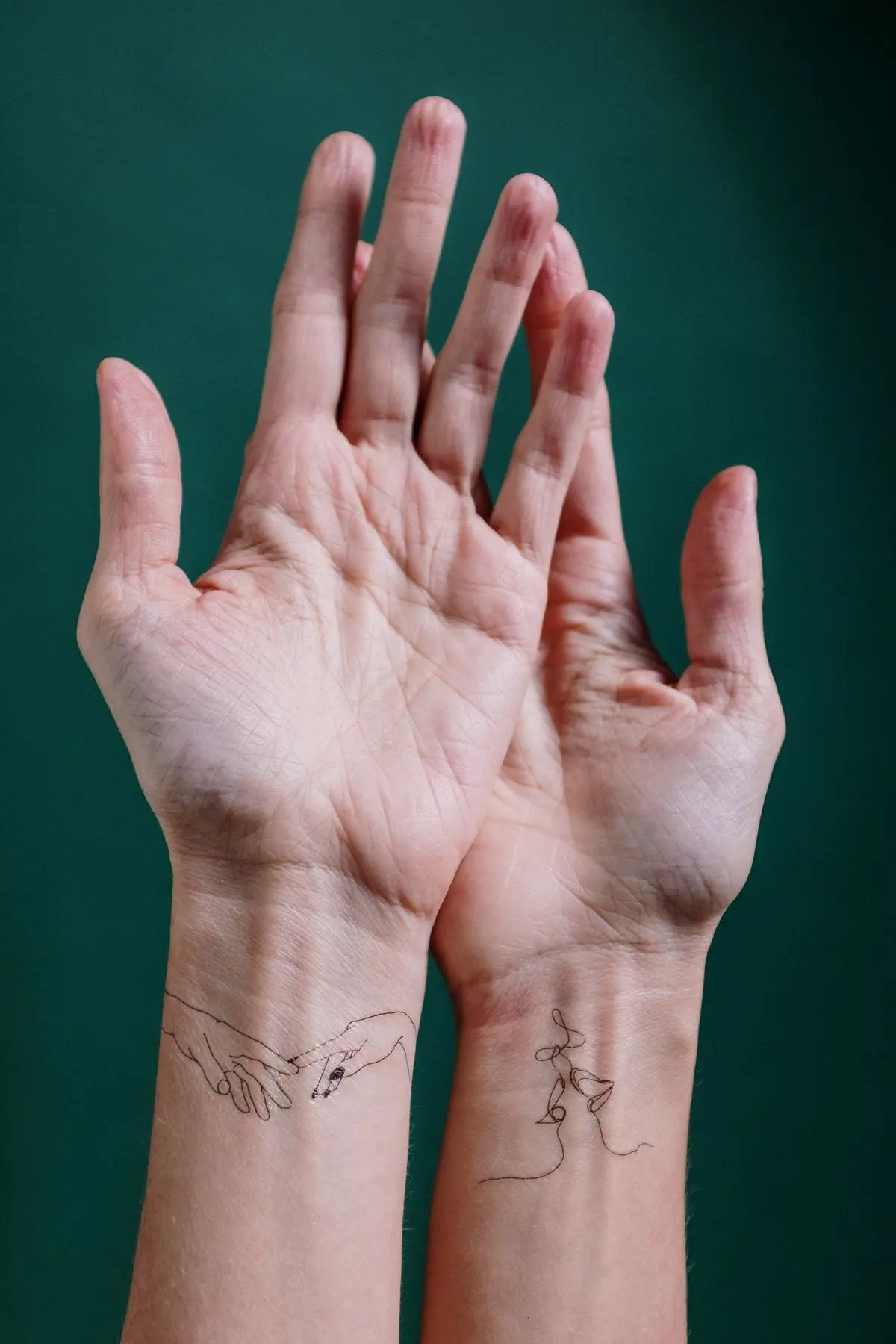

What is the difference between Fine Line and Micro tattoos?
Fine line is defined by the needle: single-needle or fine round-liner work, hairline strokes, little or no shading and lots of negative space. It took off on Instagram around 2012–2015 through Los Angeles artists like Dr. Woo and JonBoy, and it covers everything from a small botanical to a much larger fine-line composition.
Micro is defined by size. It grew out of the fine-line crossover in the mid-2010s, and most pieces fit within a 1–2 inch square or circle. At that scale, detail that looks fine in a reference image becomes an indistinguishable blob, so a good micro artist simplifies the design radically. Less ink goes in, so micro fades faster regardless of placement.
How do you tell Fine Line and Micro apart?
Measure it. A piece that fits inside a 1–2 inch square is micro. Anything larger built from hairline work is fine line.
| Attribute | Fine Line | Micro |
|---|---|---|
| Origin | LA / Instagram · 2010s | Instagram / fine-line crossover · mid-2010s |
| Typical price | $150–$300/hr · small pieces $150–$500 flat | $150–$300 flat per piece · shop minimums usually apply |
| Core palette | Black, Cool grey | Black, Cool grey |
| Best for | Small, delicate, personal pieces | Collectors getting their first tattoo and unsure about scale |
| Skip it if | You want the tattoo on fingers, feet, or heavy-wear areas | You want crisp lines 10 years in |
| Watch as it ages | Placement. Keep fine line off hands, fingers and feet if you want it crisp. | Size. If the artist suggests going bigger, that is longevity advice. |
Does Fine Line or Micro age better?
Both soften faster than bold-line styles. A well-placed fine-line piece on low-friction skin (sternum, outer forearm, back) should hold clearly for 3 to 6 years, while fingers, palms and feet can degrade within 12 to 18 months; a touch-up at 3 to 6 months is standard practice. Micro carries more risk still, because the detail is so compressed that any ink spread closes the negative space entirely.
Run a design in each style from healed to 20 years, by size, placement and sun.
An illustrative model, not a prediction.
Does Fine Line or Micro cost more?
Fine line usually bills $150–$300/hr, with small pieces at $150–$500 flat. Micro is typically priced per piece at $150–$300, and shop minimums usually apply.
Prices vary a lot by city and artist; how much a tattoo costs breaks down what drives them.
Which should you get?
- You want delicate linework and can give the design room to stay readable
- The design has detail you want to keep
- The placement is low-friction: inner arm, forearm, back, shoulder
- You want something hidden: inner arm, behind the ear, back of the neck
- The design is a single element or a short word that survives heavy simplification
- You have found an artist who specializes in micro, not just fine line
When the artist says “go bigger”
If a fine-line or micro specialist suggests going up a size, that is longevity advice, not upselling. Size is the one variable that matters most for micro, and fingers, feet and palms are where tiny tattoos blur fastest.
Whichever you lean toward, pick the artist before the design: look for healed work in that style, not just fresh photos. How to choose a tattoo artist has the checklist, and what tattoo style should I get helps if you are still deciding between more than two.