

What is the difference between American Traditional and Japanese tattoos?
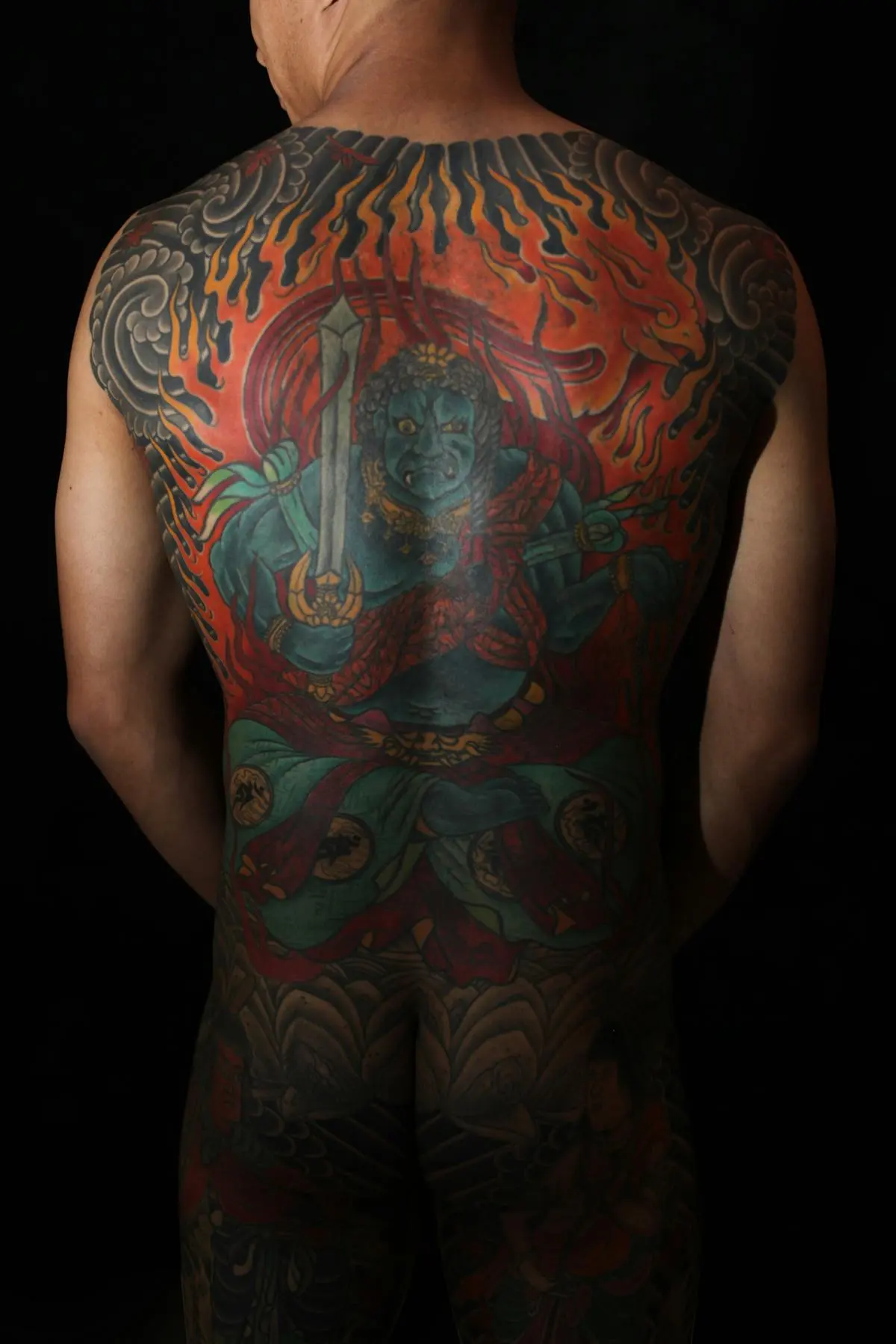
American Traditional came out of US port cities around the turn of the 20th century and works in self-contained designs: a rose, a swallow, a panther, each a finished piece that can sit on bare skin next to the others. Japanese tattooing goes back to Edo-period Japan and the woodblock-print culture of the 17th century, and it is architectural: a koi does not just go on the arm, it swims through a composition designed to flow with the body.
That changes everything downstream. Japanese work has its own motif vocabulary (koi, dragons, tigers, phoenixes, oni, peonies, chrysanthemums, maple leaves, cherry blossoms), each with symbolic meaning, and a background that connects them. Its outlines are still bold but vary more in weight to create movement, and color is symbolic: red for energy, blue-black for water and shadow, yellow-gold for koi scales. American Traditional keeps uniform heavy outlines, flat fills and a palette chosen to stay identifiable at arm’s length.
How do you tell American Traditional and Japanese apart?
Look at the space around the subject. A motif floating on bare skin is American Traditional (and, by irezumi’s own grammar, a Western shortcut). A subject wrapped in wind bars, water or clouds and flowing across a whole limb or back is Japanese.
| Attribute | American Traditional | Japanese |
|---|---|---|
| Origin | USA Navy ports · 1900–1950s | Edo-period Japan · 17th c. |
| Typical price | $150–$250/hr · flash pieces $100–$400 flat | $200–$350/hr · full sleeves $3,500–$10,000+ |
| Core palette | Black, Opaque red, Cadmium yellow, Forest green | Black, Deep red, Indigo blue, Forest green |
| Best for | First tattoos: hard to mess up with a skilled traditional artist | People committing to a large-scale piece or bodysuit |
| Skip it if | You want subtle, muted, or photorealistic work | You want a small, standalone tattoo |
| Watch as it ages | Light color fills. Black and red outlast yellow. | Scale. Irezumi designs shrunk down lose the bold structure that makes them last. |
Does American Traditional or Japanese age better?
Both are among the best-aging color styles. American Traditional is the benchmark, with 20 to 30 years before a refresh is worth considering. A well-executed Japanese sleeve is still clearly readable at 20 to 30 years, though its color softens and may want a refresh around the 15-year mark. Japanese work depends on scale: designs shrunk down lose the bold structure that makes them last.
Run a design in each style from healed to 20 years, by size, placement and sun.
An illustrative model, not a prediction.
Does American Traditional or Japanese cost more?
The hourly rates overlap, but the commitment does not. Traditional flash pieces often run $100–$400 flat. A full Japanese sleeve typically takes 40 to 80 hours of tattooing, often over one to three years, and runs $3,500–$10,000+.
Prices vary a lot by city and artist; how much a tattoo costs breaks down what drives them.
Which should you get?
- You want a standalone piece, small or medium
- You would rather collect individual tattoos over time
- You like Americana and the classic flash subjects
- You are ready for a half sleeve at minimum, ideally a full sleeve or back piece
- You value the historical lineage and want the motifs’ meanings to matter
- You want one cohesive composition rather than a collection
Can you combine American Traditional and Japanese?
Neo-Traditional borrows from both. If you start a Japanese piece, plan for it to grow: good irezumi artists design even standalone pieces with eventual sleeve or suit expansion in mind, so boxing one in with unrelated flash later works against it.
Whichever you lean toward, pick the artist before the design: look for healed work in that style, not just fresh photos. How to choose a tattoo artist has the checklist, and what tattoo style should I get helps if you are still deciding between more than two.