

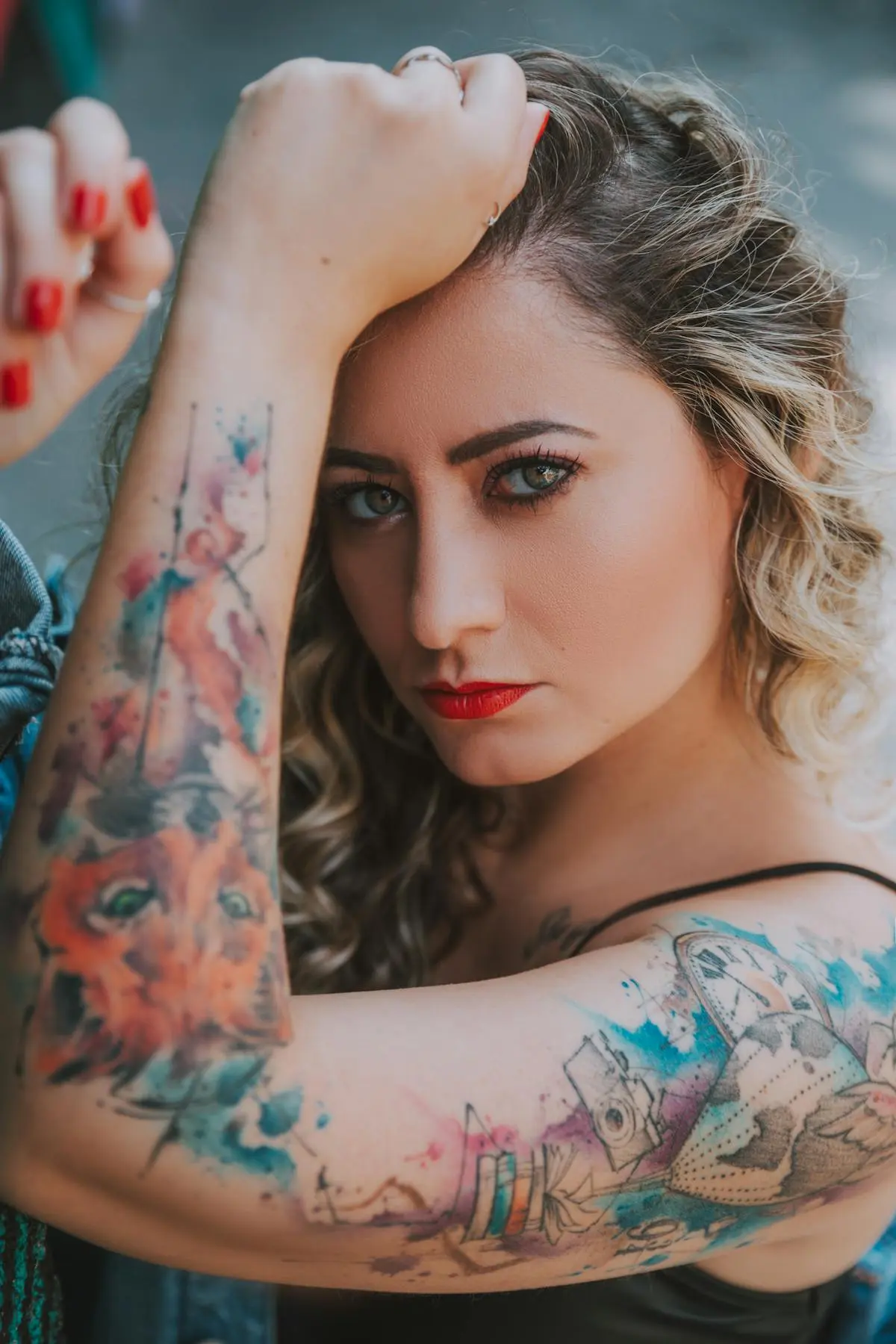
What is the difference between Traditional and Watercolor tattoos?
American Traditional was built for longevity before anyone called it that: thick, unbroken outlines, flat opaque fills in a tight palette, designed to read as a silhouette from twenty feet away. Pastels, muted tones and gradients break the style.
Watercolor, which emerged through the 2000s and early 2010s with painters-turned-tattooers like Amanda Wachob and Ondrash, does the reverse: diluted ink built up in translucent layers, controlled bleeds, background washes that fade to nothing, and color as the primary element rather than something filling a line. The palette is soft: blues, lavender, coral, warm yellow.
How do you tell Traditional and Watercolor apart?
Find the outline. Heavy black borders with flat color inside are Traditional. Color with soft, bleeding edges and no hard border is watercolor. Watercolor laid over a black linework skeleton is the common middle ground.
| Attribute | Traditional | Watercolor |
|---|---|---|
| Origin | USA Navy ports · 1900–1950s | Illustration crossover · 2010s |
| Typical price | $150–$250/hr · flash pieces $100–$400 flat | $180–$300/hr |
| Core palette | Black, Opaque red, Cadmium yellow, Forest green | Soft blue, Lavender, Coral pink, Warm yellow |
| Best for | First tattoos: hard to mess up with a skilled traditional artist | Collectors who accept the tattoo will need work at year 5–7 |
| Skip it if | You want subtle, muted, or photorealistic work | You want a 'set it and forget it' tattoo |
| Watch as it ages | Light color fills. Black and red outlast yellow. | A black outline or structure. It is what keeps the shape as the color softens. |
Does Traditional or Watercolor age better?
This is the widest aging gap of any matchup here. Traditional’s heavy lines hold the composition together as the color softens, with 20 to 30 years before a refresh is worth considering. Watercolor depends on color retention, and color retention is always temporary: a 5 to 10 year old watercolor piece looks significantly different, and once the color fades in outline-free work, the design can become illegible.
Run a design in each style from healed to 20 years, by size, placement and sun.
An illustrative model, not a prediction.
Does Traditional or Watercolor cost more?
Traditional runs $150–$250/hr, with flash pieces at $100–$400 flat. Watercolor runs $180–$300/hr.
Prices vary a lot by city and artist; how much a tattoo costs breaks down what drives them.
Which should you get?
- You want a tattoo you can set and forget
- You want color that reads at arm’s length for decades
- You like flash subjects, or want a first tattoo that is hard to get wrong
- You love the painterly look and accept it will need work around year 5 to 7
- You will ask for a black linework foundation
- The placement gets little sun, so not forearms or hands
Can you combine Traditional and Watercolor?
Watercolor with a black outline is the compromise: the line is the structure that survives as the color softens. If you want painted color with more staying power, Neo-Traditional is the other route.
Whichever you lean toward, pick the artist before the design: look for healed work in that style, not just fresh photos. How to choose a tattoo artist has the checklist, and what tattoo style should I get helps if you are still deciding between more than two.