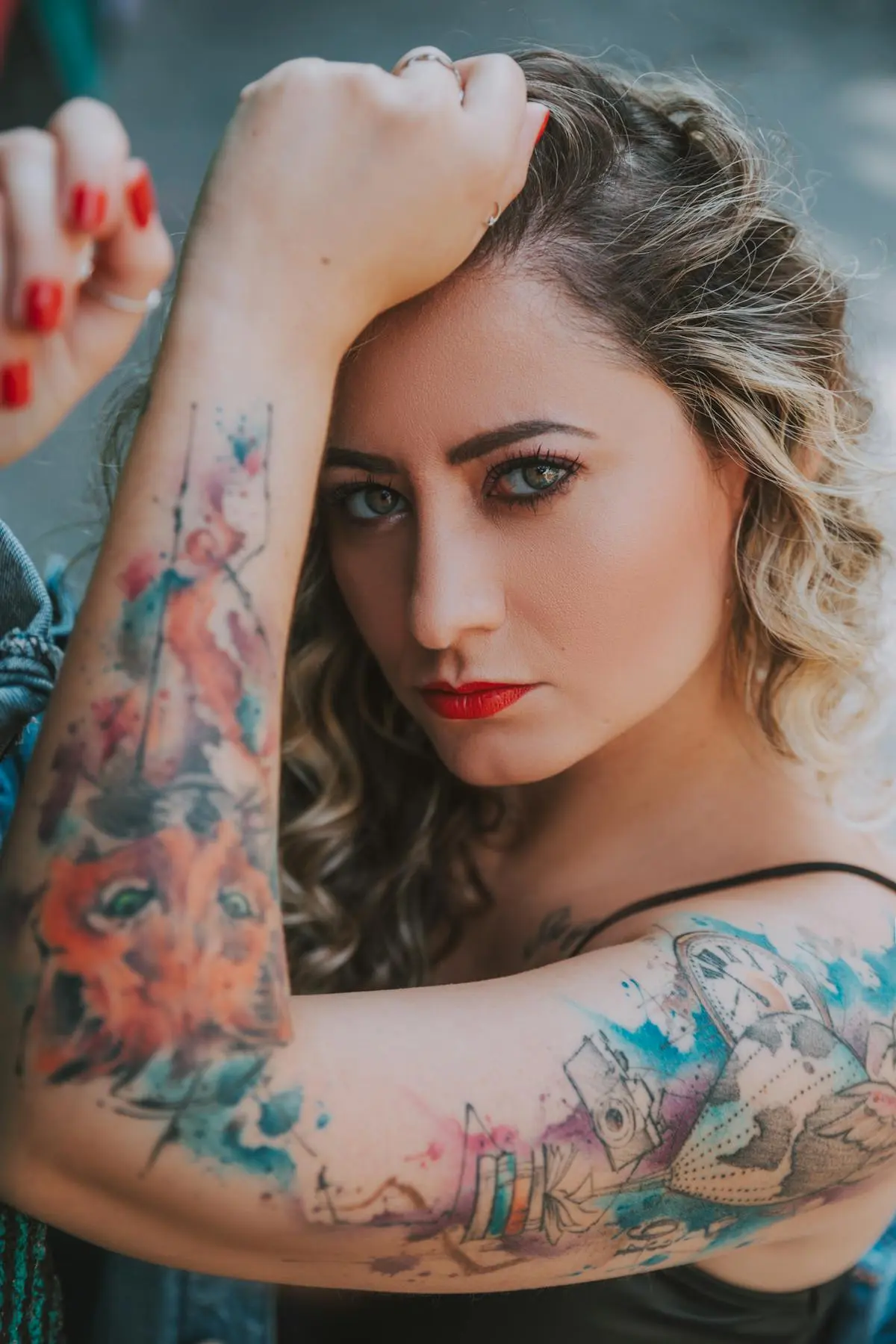
Watercolor tattooing does something no other style attempts: it replicates the look of wet paint on wet paper. Colors bleed past their edges, pigment pools in corners, the background washes fade to translucency. The effect is genuinely striking fresh: a well-executed watercolor piece looks like someone applied a painting directly to skin. The problem is that those same qualities (soft edges, low-saturation layering, no hard outlines to anchor the design) are exactly what the skin will erase first. Watercolor emerged as a distinct tattoo style through the 2000s and early 2010s, with artists like Amanda Wachob (who came from a fine arts painting background) and Ondrash demonstrating that tattoo machines could produce genuinely painterly results. The approach borrowed directly from illustration and watercolor painting: diluted ink passes built up in translucent layers, controlled bleeds at the edges, color used for form rather than fill. But where actual watercolor paintings on paper are static objects in a controlled environment, tattoos live in skin that repairs itself, absorbs UV, and changes over decades. The chemistry that makes low-saturation ink passes look translucent and soft is the same chemistry that makes them break down faster than dense, opaque fills. This isn't a matter of craft: even the best watercolor artists produce work that reads noticeably softer at five years than it did on day one. The professional consensus that has emerged is a sensible one: anchor the design with a black linework backbone, even a minimal one, so the composition remains readable when the color eventually migrates. Pure no-outline watercolor is genuinely beautiful for four to six years; after that, it requires intervention.
Pick this style if...
- Collectors who accept the tattoo will need work at year 5–7
- Pieces with a black linework foundation
- Lower-sun-exposure placements
Skip this style if...
- You want a 'set it and forget it' tattoo
- You're getting it on forearms or hands (UV)
- You're skeptical: this is the one style where the skepticism is warranted
Notable artists
A starting point. Follow their work, don't just book the first DM-slot you can get.
- Ondrash
- Amanda Wachob
- Joice Wang
The rules of the style
- Soft edges over hard outlines: watercolor tattooing mimics the look of watercolor paint, where color bleeds beyond defined boundaries. Hard black outlines are avoided or used sparingly as structural anchors.
- Color as the primary element: unlike most tattoo styles where black linework defines the form and color fills it in, watercolor tattoos use color washes as the form itself.
- Layered diluted pigment: the watercolor effect is achieved by diluting ink to various concentrations and layering them, simulating the translucency of actual watercolor paint.
- An anchor element helps longevity: pure watercolor with no black anywhere tends to blur and fade faster. Many experienced artists include a minimal black element (linework, silhouette, or outline) to anchor the design as color softens.
- Subject matter is usually organic: botanicals, animals, abstract splashes, cosmic elements. Geometric or architectural subjects tend to look awkward in the style.
- Aging is the honest conversation: watercolor tattoos age faster than any bold-outline style. A 5–10 year old watercolor tattoo looks significantly softer than the day-one photo. Artists should show clients healed examples before booking.
Color palette
- Soft blue
- Lavender
- Coral pink
- Warm yellow
- Teal (secondary)
- Sage green (secondary)
- Dusty rose (secondary)
- Peach (secondary)
Saturated, opaque colors fight the style's aesthetic. The palette should feel like paint on wet paper: soft, blended, slightly unpredictable at the edges.
Aftercare for this style
Watercolor follows the same basic fresh-tattoo routine as other styles: follow your artist's instructions, keep the area clean, and protect the healed tattoo from UV exposure.