

What is the difference between Black & Grey and Blackwork tattoos?
Black-and-grey builds every value from a single black pigment diluted into grey wash, with the skin itself as the lightest highlight. It came out of 1970s Los Angeles prison culture, was refined through Chicano tattooing, and works across realism, portraits, religious imagery and florals. Its technical standard is a gradient so smooth you cannot see where one grey ends and the next begins.
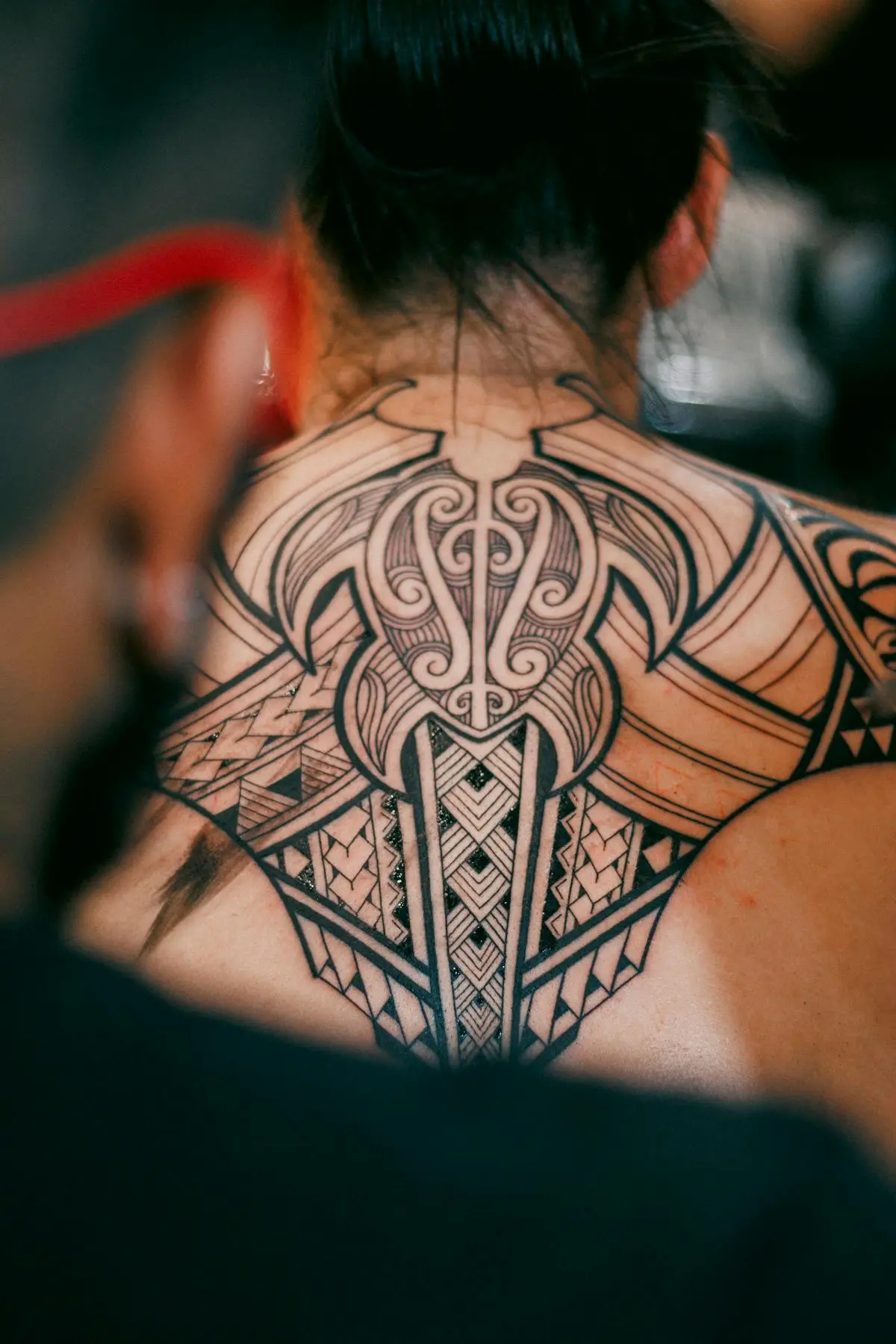
Blackwork limits the whole visual system to pure black and bare skin: bold geometric fills, ornamental pattern, neo-tribal and stark silhouettes. It is graphic rather than photographic, and its negative space is designed as carefully as the black. Its own rule is blunt: if you see grey shading, it is not blackwork, it is black-and-grey.
How do you tell Black & Grey and Blackwork apart?
Look for grey. Any soft gradient or wash means black-and-grey. Solid black shapes with hard edges against skin mean blackwork. Dotwork is the edge case: it builds tone from dot density instead of wash, and it usually lives in the blackwork camp.
| Attribute | Black & Grey | Blackwork |
|---|---|---|
| Origin | 1970s California prison tattooing | Ancient tribal + modern revival |
| Typical price | $200–$350/hr | $180–$300/hr |
| Core palette | Black, Dark grey, Mid grey, Light grey | Black |
| Best for | Portraits, religious imagery, fine art references | Collectors prioritizing longevity |
| Skip it if | You want bold high-contrast like American Traditional | You want soft, muted, or 'pretty' work |
| Watch as it ages | Value range. Strong blacks anchor the design as the light greys soften. | Negative-space width. Gaps that look generous now are the ones that survive. |
Does Black & Grey or Blackwork age better?
Blackwork is the most durable option there is. Dense fills may spread fractionally at the edges over decades, but they do not fade the way grey wash does. Black-and-grey ages more gracefully than color because there is no hue shift; it just softens. The lightest greys go first, so strong blacks are what anchor it.
Run a design in each style from healed to 20 years, by size, placement and sun.
An illustrative model, not a prediction.
Does Black & Grey or Blackwork cost more?
Black-and-grey typically bills $200–$350/hr and takes more hours than people expect, because the value range is built in several passes at different dilutions. Blackwork runs $180–$300/hr, with heavy saturation sessions for solid fills.
Prices vary a lot by city and artist; how much a tattoo costs breaks down what drives them.
Which should you get?
- You want realism, portraits, religious imagery or fine-art references
- You want depth and soft shading without the fading risk of color
- You are planning a large sleeve or back piece
- Longevity is your top priority
- You want a bold, graphic statement piece
- You want contrast that reads on skin tones where color does not
Can you combine Black & Grey and Blackwork?
They can be combined in one piece, but the techniques and goals differ, so name the one you mean. "A black tattoo" does not tell an artist which.
Whichever you lean toward, pick the artist before the design: look for healed work in that style, not just fresh photos. How to choose a tattoo artist has the checklist, and what tattoo style should I get helps if you are still deciding between more than two.