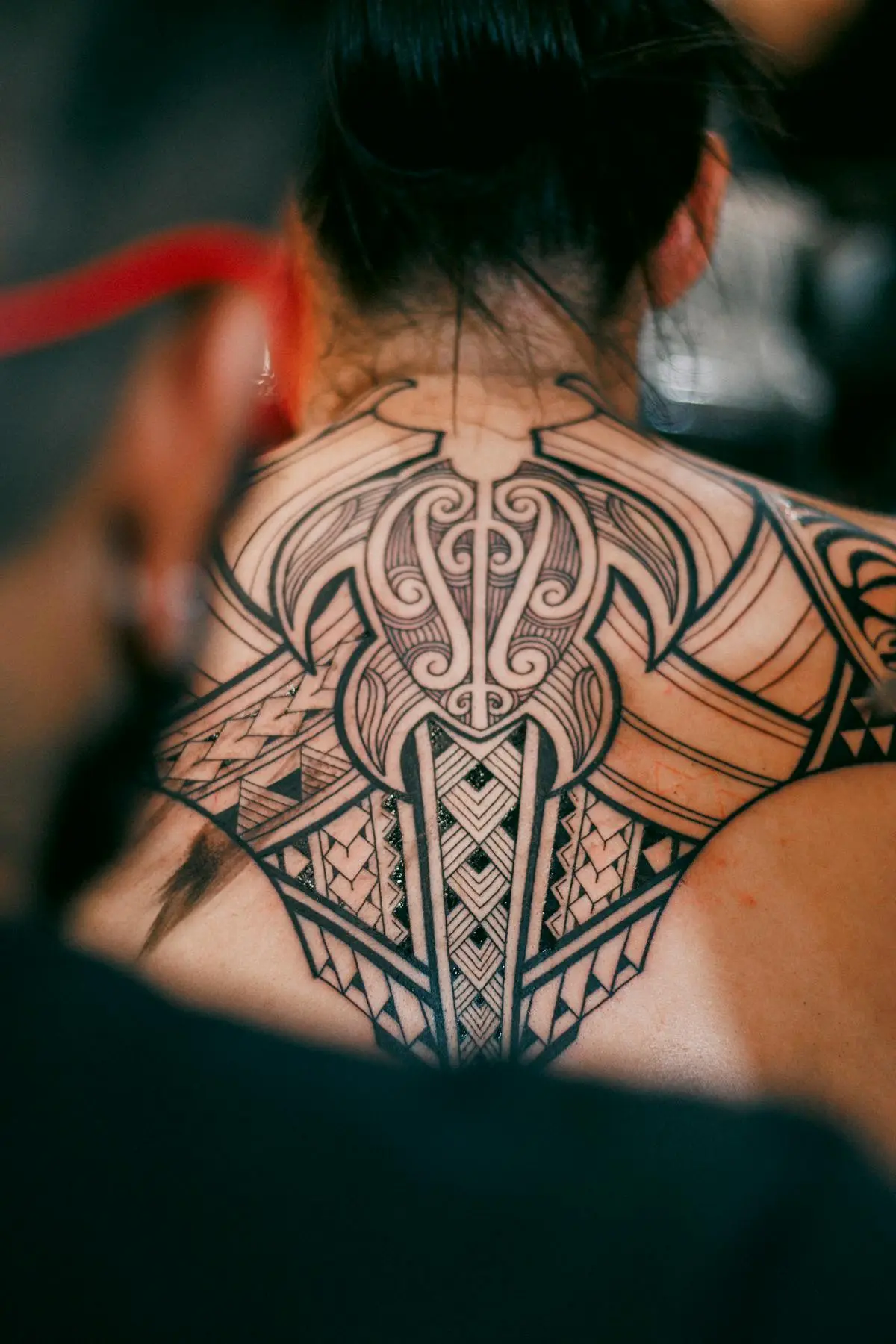
Blackwork is any tattoo that uses only black ink, but that single constraint produces an enormous range of work. Bold geometric fills, intricate ornamental patterns, dotwork mandalas, neo-tribal body suits, stark illustrative silhouettes: all of these are blackwork. The unifying logic is that the entire visual range of the piece (form, depth, texture, shadow) must be built from the contrast between solid black and bare skin. No color, no grey wash. The style traces roots to indigenous tattooing traditions worldwide, where solid black designs have been practiced for thousands of years, and saw a sharp contemporary revival in the 1980s and 1990s among Western artists drawing on Polynesian and Maori visual vocabulary. Artists like Thomas Hooper and the collective around Darkside Tattoo formalized blackwork as a distinct contemporary category. Technically, blackwork is unforgiving in a way that color styles are not: there is no secondary element to distract from a misplaced line or an uneven fill. What you see is what there is. On the upside, solid black ages better than any other tattoo medium. The ink can spread slightly over decades but won't fade the way color does, and heavy fills often look better at 20 years than at 6 months. Skin tone is largely irrelevant because the value contrast between deep black and any skin tone is sufficient. Blackwork is also the most viable option for covering old or blown-out tattoos, since dense black can reclaim almost any skin.
Pick this style if...
- Collectors prioritizing longevity
- Skin tones where color doesn't read well
- Bold statement pieces, sleeves, back pieces
Skip this style if...
- You want soft, muted, or 'pretty' work
- You're scared of heavy saturation sessions
- You want easy coverup/removal later
Notable artists
A starting point. Follow their work, don't just book the first DM-slot you can get.
- Thomas Hooper
- Valerie Vargas
- Nazareno Tubaro
The rules of the style
- Black ink only. No color, no grey wash, no color accents. The entire visual range is achieved through the contrast of solid black against skin.
- Graphic, not photographic. Blackwork is flat and high-contrast by design. It does not attempt to simulate depth through gradient; it achieves depth through composition and negative space.
- Bold, confident marks. Lines should be intentional and definitive. Hesitant or scratchy linework is amplified in blackwork because there is no color or shading to distract from it.
- Negative space is as important as black: the shapes created by the untattooed skin are part of the design. Experienced blackwork artists design both simultaneously.
- Scale-friendly. Blackwork holds at large and small scales better than most styles, and heavy black fills age exceptionally well.
- No grey wash allowed. If you see grey shading, it is not blackwork, it is black-and-grey. They are different styles with different aesthetics and aging characteristics.
Color palette
- Black
Adding any color or grey wash moves the tattoo out of the blackwork category. The one-color constraint is the style's defining rule.
Aftercare for this style
Blackwork follows the same basic fresh-tattoo routine as other styles: follow your artist's instructions, keep the area clean, and protect the healed tattoo from UV exposure.