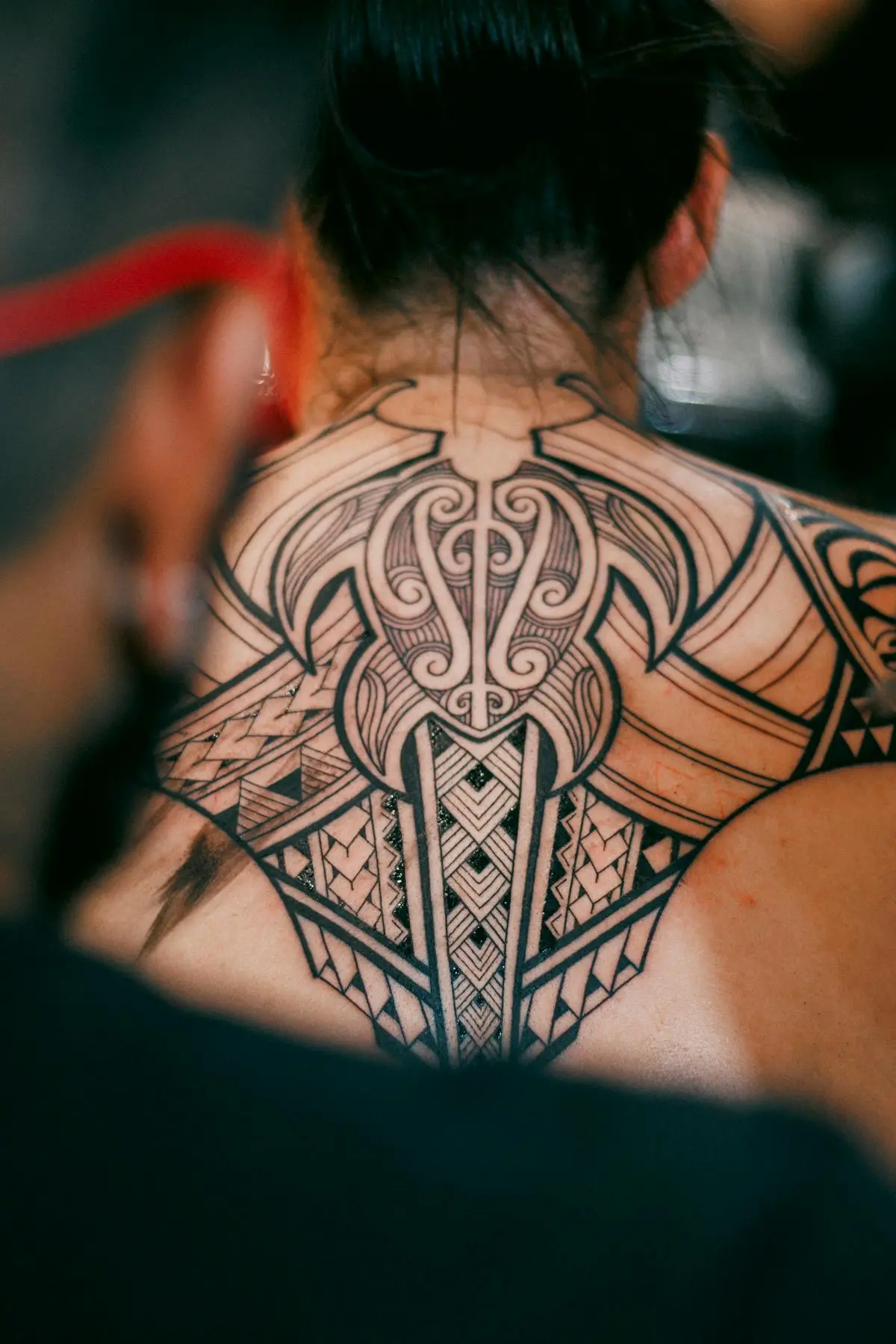
Tribal tattooing is not a style; it's a category covering dozens of distinct traditions, each with its own visual grammar, cultural meaning, and centuries of practice. Polynesian tattooing (encompassing Samoan pe'a, Hawaiian kakau, Marquesan tatau), Maori tā moko, Filipino Kalinga batok, and Dayak borneo tattooing are among the most recognizable, but the lineage of indigenous marking practices extends across the Pacific, Africa, and the Americas. What they share is an approach: solid black geometric and organic forms that follow the body's contours rather than sitting on it as a flat graphic, carrying encoded meaning about lineage, rank, and life events rather than functioning as decoration. These traditions predate Western tattooing by thousands of years. Mummified bodies with tattoos dating to 3300 BCE have been found in the Alps, and Polynesian tattooing traditions are documented from at least 2000 BCE. The generic "tribal" work that flooded Western tattoo shops in the late 1990s (angular spikes, armbands, generic Polynesian-adjacent fills) was a commercial simplification of these traditions that has not aged well aesthetically or culturally. It lacks both the visual sophistication of authentic lineage work and the meaning that gives it weight. Contemporary artists working seriously in specific traditions, like Keone Nunes in Hawaiian, the Su'a Suluape family in Samoan pe'a, and practitioners of Filipino hand-tap, are returning to source. If you're drawn to tribal aesthetics, the most respectful and visually compelling path is finding an artist with genuine lineage in a specific tradition, not borrowing an aggregate of surface-level motifs.
Pick this style if...
- People with cultural ties to a specific tradition
- Large-scale, flowing, body-architecture pieces
- Collectors who value meaning over aesthetics
Skip this style if...
- You want the generic 1998 tribal armband (seriously, don't)
- You lack cultural ties: consider neo-tribal or blackwork instead
Notable artists
A starting point. Follow their work, don't just book the first DM-slot you can get.
- Keone Nunes (Hawaiian)
- Apo Whang-Od (Kalinga)
- Su'a Suluape family (Samoan)
The rules of the style
- Black ink only: all traditional tribal tattooing uses solid black. No color, no grey wash. The entire visual language is black form against skin.
- Bold solid fills: tribal patterns are not outlines with empty interiors. They are solid black shapes. The mass of black is the design.
- Culturally specific vocabulary: Polynesian, Maori (tā moko), Filipino (batok), Hawaiian, and other traditions have distinct motifs, placements, and meanings. These are not interchangeable.
- Earned or inherited in traditional context: in source cultures, tribal tattoos communicate lineage, status, and life events. Getting motifs you haven't earned is a live cultural conversation; research your specific tradition before booking.
- Flows with the body: traditional tribal designs are not flat graphics applied to the body. They are designed to follow muscle groups, contour limbs, and respond to the body's topography.
- No shading, no gradients: tribal is a binary style. Black and skin only. Any shading or gradient moves the work into a different category (blackwork or grey wash).
Color palette
- Black
Color tribal tattooing exists as a Western fusion, but it contradicts the source aesthetic. If you want tribal motifs with color, that's a hybrid style, so discuss with your artist whether it fits what you're after.
Aftercare for this style
Tribal follows the same basic fresh-tattoo routine as other styles: follow your artist's instructions, keep the area clean, and protect the healed tattoo from UV exposure.