
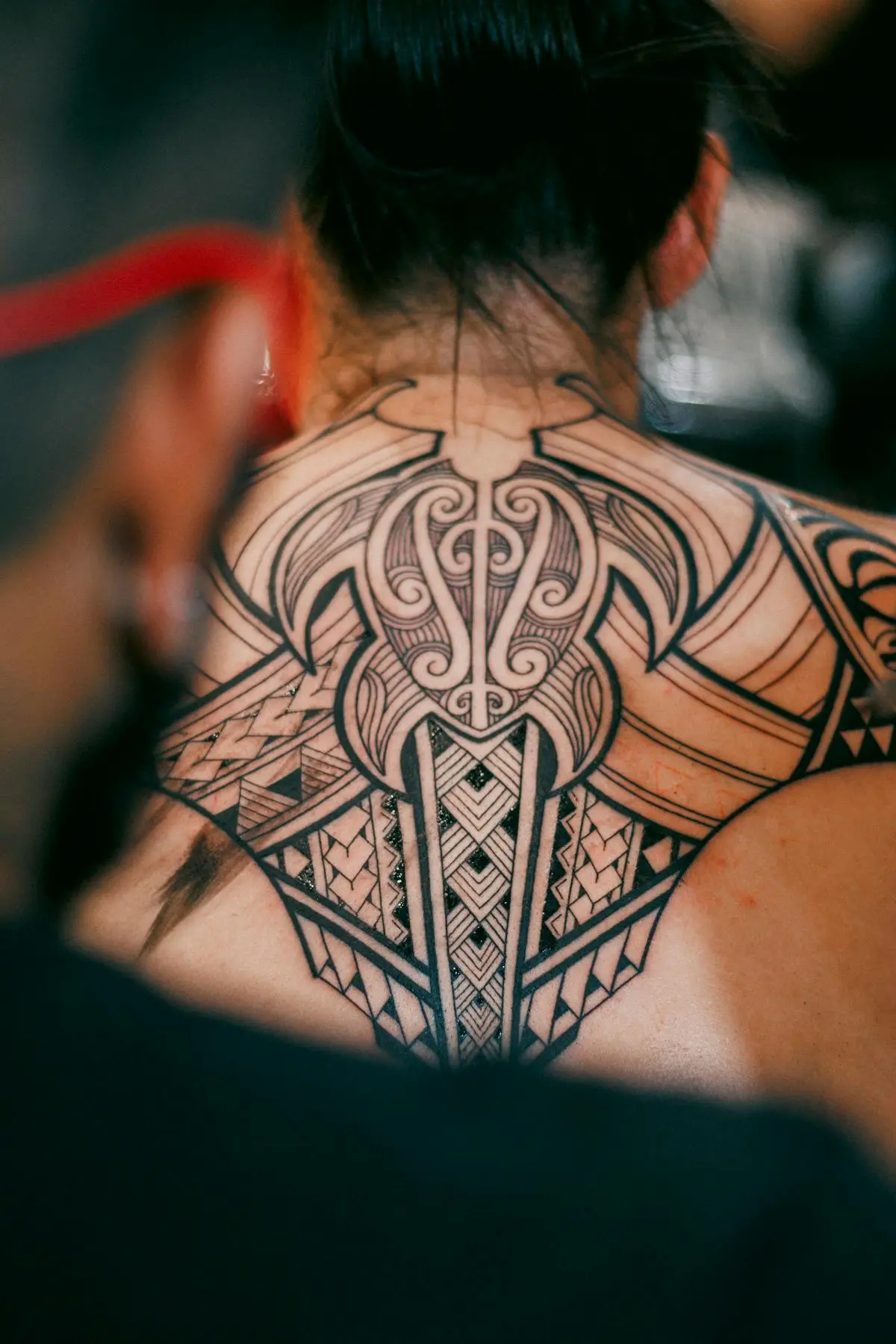

What is the difference between Blackwork and Dotwork tattoos?
Blackwork is a constraint: black ink only, no grey wash, with the whole image made from the contrast between solid black and skin. It covers bold geometric fills, ornamental pattern, neo-tribal and stark silhouettes, and it is flat and graphic by design.
Dotwork is a technique: no continuous lines, with tone set entirely by dot density, tightly packed for near-black and widely spaced for skin tone. It descends from stipple engraving, the copper-plate method behind 18th- and 19th-century scientific illustration, and was revived in the 2000s within the blackwork and geometric communities. That is how it can render shadow, gradient and texture on mandalas, skulls, botanicals and animals.
How do you tell Blackwork and Dotwork apart?
Get close. Solid, even black with hard edges is blackwork. Tone that breaks up into visible dots, darker where they are denser, is dotwork. A crisp outline filled with stippling is a hybrid, and a common one.
| Attribute | Blackwork | Dotwork |
|---|---|---|
| Origin | Ancient tribal + modern revival | Stipple engraving tradition, modern revival 2000s–2010s |
| Typical price | $180–$300/hr | $180–$300/hr |
| Core palette | Black | Black |
| Best for | Collectors prioritizing longevity | Mandalas, sacred geometry, and symmetrical patterns |
| Skip it if | You want soft, muted, or 'pretty' work | You want large solid-black fills, which belong to blackwork |
| Watch as it ages | Negative-space width. Gaps that look generous now are the ones that survive. | Dot spacing relative to size. Cramped dots merge first. |
Does Blackwork or Dotwork age better?
Blackwork’s dense fills are the most durable thing in tattooing. Dotwork ages comparably to grey wash: dots spread slightly and tight clusters relax into smoother tone, so on a stable placement a good piece can look more cohesive at 10 to 15 years than on the day it was done. Cramped dot spacing is what fails first.
Run a design in each style from healed to 20 years, by size, placement and sun.
An illustrative model, not a prediction.
Does Blackwork or Dotwork cost more?
Hourly rates are the same ($180–$300/hr for both), but the hours are spent differently. Dotwork is slow, because smooth gradients take an enormous number of precisely placed dots. Blackwork’s solid fills mean long, heavy saturation sessions instead.
Prices vary a lot by city and artist; how much a tattoo costs breaks down what drives them.
Which should you get?
- You want maximum contrast and the best-aging work there is
- You want a bold statement piece, sleeve or back piece
- You can handle heavy saturation sessions
- You want subtle shading and gradient in black ink
- You love mandalas, sacred geometry and symmetrical patterns
- You are not on a tight budget or timeline
Can you combine Blackwork and Dotwork?
Often. Dotwork shading inside geometric or fine linework is a distinct look many artists offer. Just know that a piece with solid lines is hybrid work, not pure dotwork.
Whichever you lean toward, pick the artist before the design: look for healed work in that style, not just fresh photos. How to choose a tattoo artist has the checklist, and what tattoo style should I get helps if you are still deciding between more than two.