

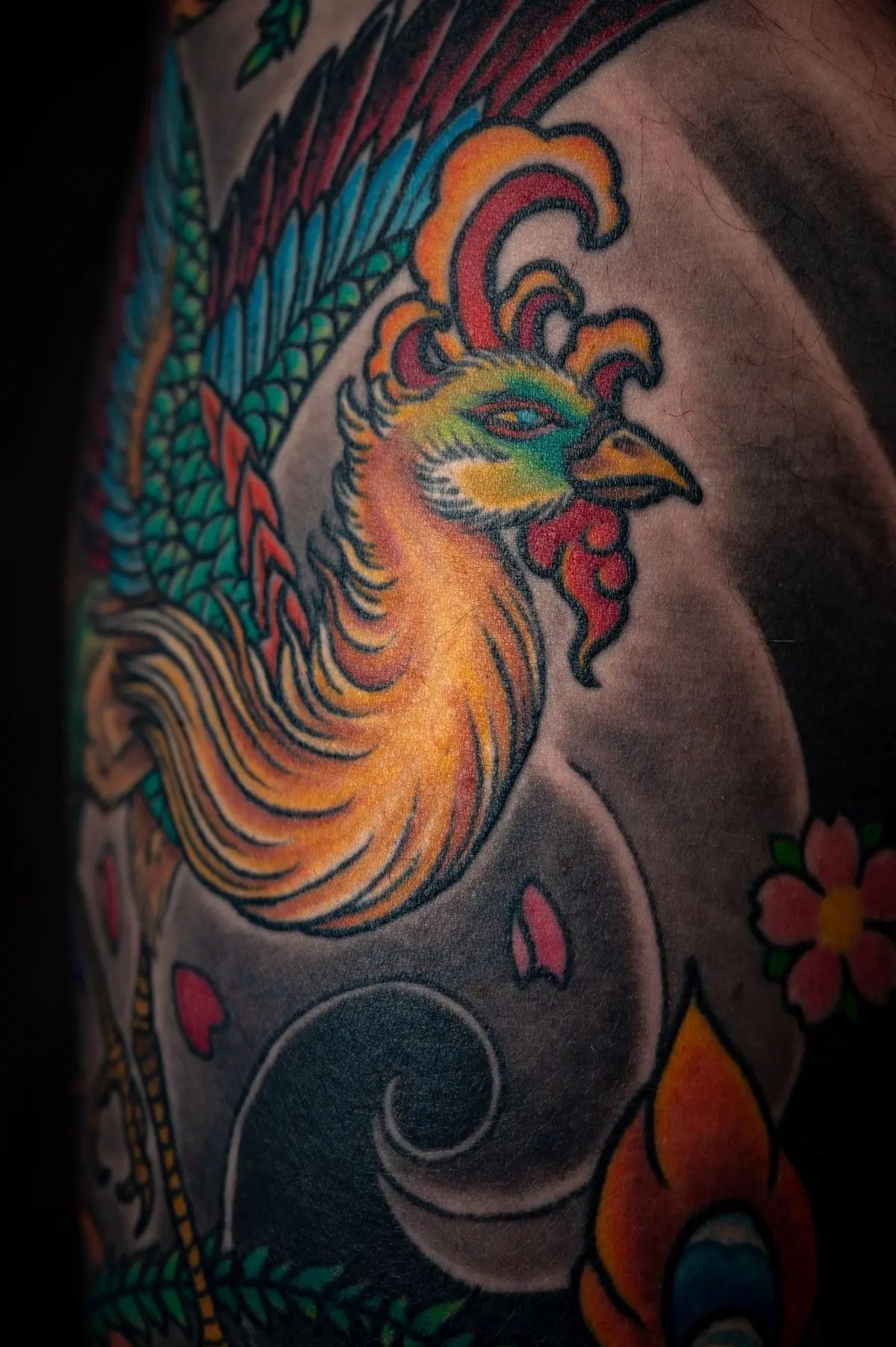
What is the difference between American Traditional and Neo-Traditional tattoos?
Neo-Traditional grew out of American Traditional through the late 1990s and 2000s, as artists trained in the traditional lineage started studying illustration, printmaking and fine art. The skeleton did not change: both styles are built on heavy black outlines that keep the shape as the skin ages.
What changed is everything inside the line. Traditional keeps to flat, opaque fills in red, yellow, green, blue and occasionally purple, and to the flash vocabulary of roses, eagles, anchors, daggers, panthers, ships and swallows. Neo-Trad layers its color to model shadow and highlight so the piece looks painted, varies its line weight for depth, adds decorative framing like banners and filigree, and treats any subject as fair game: portraits, architecture, surreal animals, botanical compositions.
How do you tell American Traditional and Neo-Traditional apart?
Look inside the outlines. Flat, solid color is Traditional. Shaded, rendered color with highlights is Neo-Trad. Traditional is designed to read as a silhouette from across a room; Neo-Trad adds interior detail that rewards a closer look.
| Attribute | American Traditional | Neo-Traditional |
|---|---|---|
| Origin | USA Navy ports · 1900–1950s | Early 2000s evolution of American Traditional |
| Typical price | $150–$250/hr · flash pieces $100–$400 flat | $180–$300/hr |
| Core palette | Black, Opaque red, Cadmium yellow, Forest green | Black, Deep red, Forest green, Cobalt blue |
| Best for | First tattoos: hard to mess up with a skilled traditional artist | Collectors who love traditional aesthetics but want more color range |
| Skip it if | You want subtle, muted, or photorealistic work | You want photographic realism |
| Watch as it ages | Light color fills. Black and red outlast yellow. | Lighter tones and fine interior detail. The outline will outlast them. |
Does American Traditional or Neo-Traditional age better?
Both age well, because the bold outline does the same work in each. Traditional is the benchmark: thick lines and flat opaque fills, with 20 to 30 years before a refresh is even worth considering. Neo-Trad ages almost as well. The shaded color inside each shape softens and compresses over time, usually gracefully, and the pieces that do not hold up are the ones where the artist chased detail at the expense of structure.
Run a design in each style from healed to 20 years, by size, placement and sun.
An illustrative model, not a prediction.
Does American Traditional or Neo-Traditional cost more?
Neo-Trad usually costs more at the same size because the rendering takes longer: roughly 20–40% more than traditional flash, with custom work from a specialist reaching $250–$350/hr. A flash piece that takes 90 minutes might take 2.5 to 3 hours in Neo-Trad.
Prices vary a lot by city and artist; how much a tattoo costs breaks down what drives them.
Which should you get?
- You want the tattoo most likely to still look sharp in decades
- You like classic flash subjects, or want to pick a design straight off the wall
- It is your first tattoo: a skilled traditional artist is hard to go wrong with
- You love the traditional look but want more color range and depth
- Your subject is not in the flash vocabulary: a specific animal, a portrait, an object
- You want a medium-to-large piece with a narrative or stylized subject
Can you combine American Traditional and Neo-Traditional?
Yes. The outlines share a weight class, so the two sit comfortably on the same arm, and adding to existing traditional work is one of the things Neo-Trad is best at.
Whichever you lean toward, pick the artist before the design: look for healed work in that style, not just fresh photos. How to choose a tattoo artist has the checklist, and what tattoo style should I get helps if you are still deciding between more than two.