How Much to Tip a Tattoo Artist
Direct answers on tattoo tipping etiquette: the standard amount, cash vs. card, when to tip more, and the one case where you shouldn't tip at all.
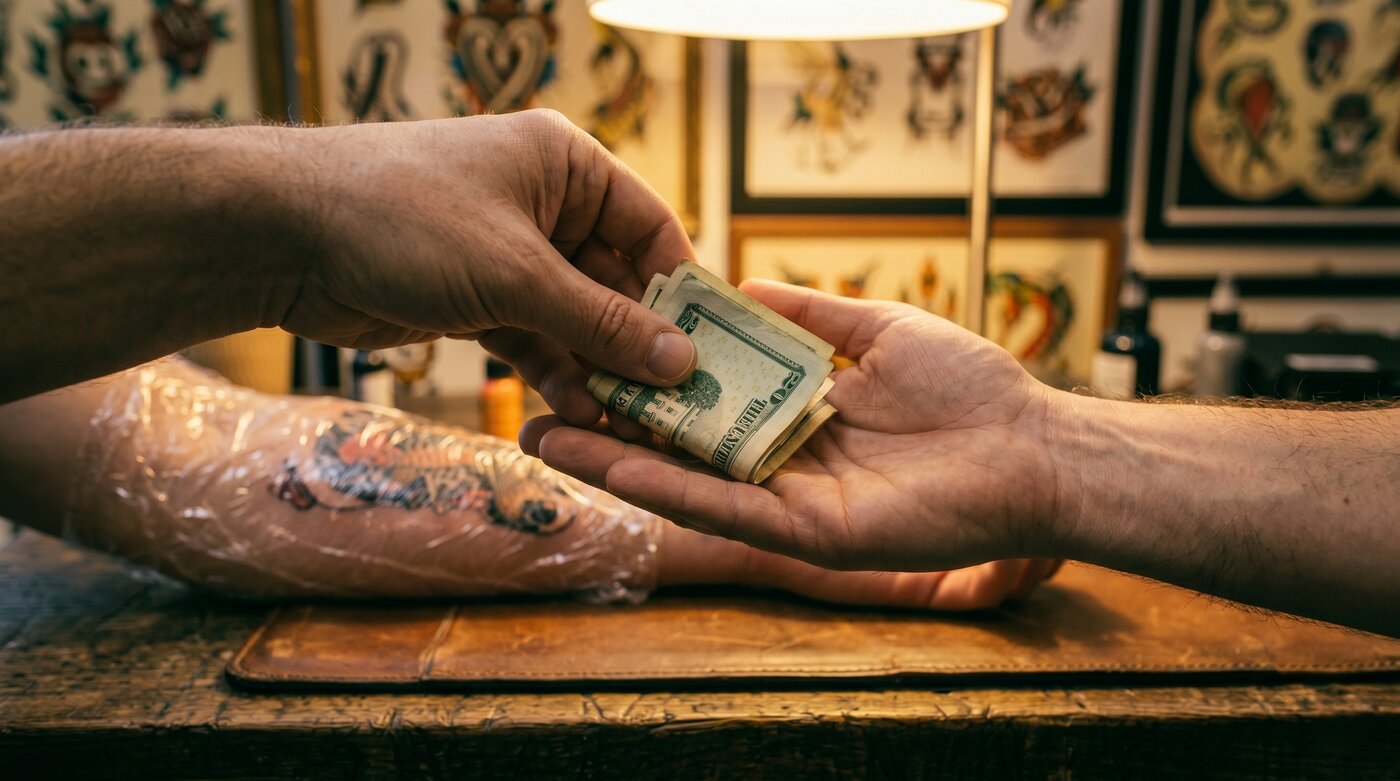
Tip your tattoo artist 20%. That’s the short answer. For most sessions, it’s also the complete answer.
Here’s the longer version for everyone who wants to understand why, and how to handle the edge cases.
The standard
15–20% is the floor. Twenty percent is the norm for solid work done on time with good communication. If the session ran long because of complexity, or the artist stayed patient through your nervous questions, 25% is appropriate.
There is a session minimum of $20. If your tattoo costs $100 and 20% comes out to $20, tip $20. If 20% comes out to $15, tip $20. Below $20, you’re signaling you didn’t value the time.
Quick math: Your $350 session → tip $52–$70. Bring $70 in cash and you’re covered for any outcome in that range.
Cash is the preference
Most artists prefer cash tips over card. The reason is simple: Venmo and Square take a percentage cut, and the shop may take a cut of card tips. Cash goes directly to the artist.
Some shops do pass card tips through intact; if you’re not sure, ask. “Do you prefer cash for tips?” is a normal question and any artist will appreciate you asking.
When to tip more
- The artist accommodated a reschedule. Good artists are booked out weeks or months. Rescheduling costs them a slot that someone else wanted. A bump to 25–30% acknowledges that.
- The piece was significantly more complex than quoted. If your “simple” design turned into a 4-hour session, the tip should reflect actual time, not the underestimate.
- You’ve been a difficult client and you know it. Excessive break requests, changing the design mid-session, running late: these are real costs. Tip accordingly.
- You’re a repeat client. Artists remember regulars who take care of them. That goodwill pays back in scheduling priority and extra care on your next piece.
A note on shop owners
If your artist owns the shop and set their own rates, the tip is still expected. Owner-set rates are designed to cover operating costs, not to pad artist income. The tip is still how they’re compensated for the discretionary part of the work.
When not to tip more
You do not need to tip more than 20% because:
- The art is beautiful (that’s what the rate covers)
- You’ve been a perfectly normal, easy client (baseline)
- The session ended on time as scheduled
Good work on an easy client is the job. The 20% tip acknowledges professional execution.
The one case where you shouldn’t tip
If the work is objectively bad, not stylistically different from what you envisioned but technically wrong, tipping signals acceptance.
Technical failures that fall in this category:
- Blowouts: ink spread outside the lines into the surrounding skin
- Poor line work: inconsistent weight, shaky lines, gaps
- Patchy fill: uneven color saturation that won’t resolve with healing
Your preference for a different style, a bolder line, a slightly different placement than you imagined: that’s not a technical failure. Don’t withhold a tip over taste.
If the work is genuinely wrong, don’t tip and don’t rebook. A reputable shop will offer a touch-up; if they won’t, that’s the data point you needed.
Why this matters beyond the money
Artists remember clients. A generous tipper who shows up on time, stays flexible, and communicates clearly is exactly the kind of client artists prioritize when a last-minute slot opens up. They’ll check in with you first. They’ll put more care into your appointment prep.
This isn’t transactional; it’s how any long-term professional relationship works. If you want the best version of your artist’s work, be the client worth making the effort for.
Related: How much does a tattoo cost?, calculating your base price before the tip. How to choose a tattoo artist, part of building a working relationship with your artist. Your first tattoo checklist, full prep guide for your first appointment.